Replacing a Wood Deck with Composite: Keep the Frame, Expand or Rebuild?
· By Kirill Ostrovskii · Updated October 23, 2026
Changing from wood boards to composite creates an opportunity to rethink the whole deck. The right scope depends on the structure underneath and whether the existing footprint still works for your home.
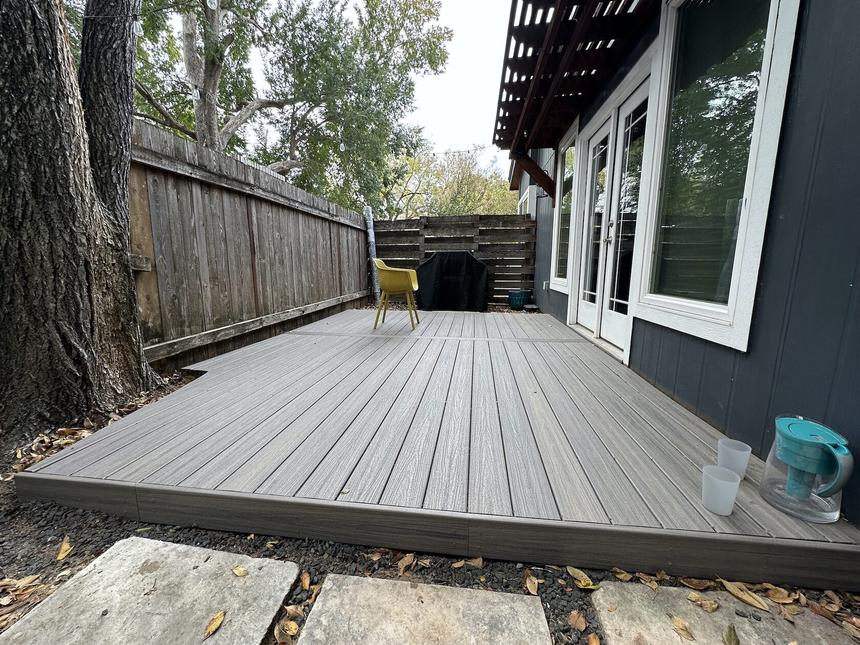
Three different project scopes
A resurfacing project replaces the walking surface while retaining a suitable structure. An extension adds usable area and the supports needed for it. A full rebuild replaces the structure to the extent defined in the proposal. These approaches can be combined, but they should never be confused in the estimate.
If you want a larger dining area, different stairs or a new elevation, start with the finished layout. Choosing the boards first can lock you into an old footprint that no longer meets your needs.
When retaining framing can make sense
Retaining a frame can be appropriate when its condition, layout and remaining serviceability support the planned investment. Joists, supports, connections, flashing and deck height all need assessment. Removing boards may reveal conditions that were not visible during the first visit.
The frame also needs to meet the selected decking manufacturer’s support and fastening requirements. Existing spacing suitable for one wood board is not automatically suitable for a different composite product. Borders, seams and stair treads may need additional support.
An extension needs new structural planning
Widening the deck adds loads and can change beam spans, support locations and stair geometry. The connection between old and new framing needs to be designed for the actual layout. Matching the surface level is only one part of that work.
Our Georgetown rebuild and expansion reached 420 sq ft with reinforced framing, added posts, Trex decking, metal railing and a centered stair. It illustrates how footprint, structure and finish can be planned together.
When a full rebuild is the clearer investment
If major structural components are unsuitable, or the new layout requires extensive changes, a new frame may be more practical than preserving a patchwork of old and new components. The decision should be based on documented conditions and a comparable scope.
Long-lived decking does not extend the life of an inadequate frame beneath it. Compare the expected use of the finished deck, future access to the structure and the cost of removing new boards if concealed framing needs replacement later.
Choose boards after the scope is clear
Then compare the exact Trex or TimberTech collection, color, profile and fastening system. Review fascia, railing and stairs at the same time so the finished project has a consistent appearance.
Our wood-to-composite deck budget calculator is useful for a starting comparison of new construction or a full rebuild. A retained-frame or partial-extension scope needs an on-site adjustment; the tool is not a structural assessment. Explore our composite installation service for the next step.